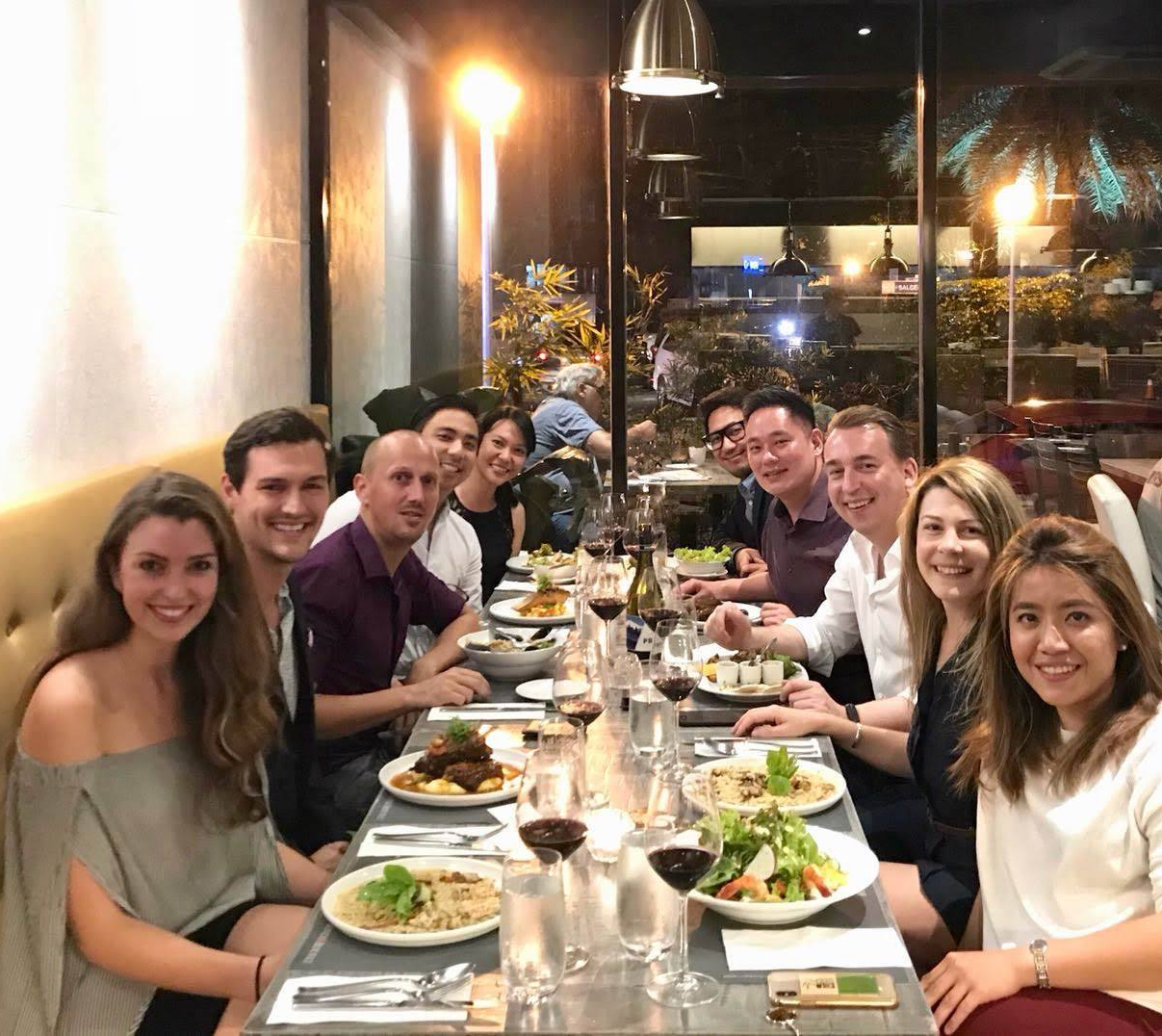
Across perfectly manicured greenspaces lit by twinkle lights and storefronts laced with Louis Vuitton and Dior we walked. Until the ultra-modern open air mall dumped us onto a dirty concrete building lined street where the only light came from a tin shack convenience store. A mangy stray dog walked by. In as stark a juxtaposition to the outdoor mall we had just come through sat in one of these old concrete buildings a nice restaurant franchise. Inside it, a long table for ten where for the rest of the night we learned about the challenges in Filipino infrastructure, vaccine cold chain startups, and the Ubers and Airbnbs of Philippino digital healthcare. A unique symphony of conversation merging my passions of global health and digital health. And Johanna Wiese was its conductor.
A former employee with Endeavor, a high impact entrepreneurial movement (https://endeavor.org/), she organized the dinner and had recently switched to working for mClinica, a Silicon valley based digital health company with three tech products improving global health through independent pharmacies in Malaysia, Indonesia, the Philippines, Cambodia, Thailand, and Vietnam (http://www.mclinica.com/). We sat across from her and Christian, a venture capitalist working with the digital health venture arm of one of the Philippines largest family conglomerates, Ayala. They shared on the exciting opportunities of working in the Philippines, and the opportunities to improve inefficiencies, but inefficiencies that existed for a reason, or, rather, several: rule of law, foreign ownership restrictions, infrastructure, and government turnover corruption, and nepotism.
The Philippines has rampant challenges with its companies and governments honoring contracts, which keeps most investors away. They are ranked 173rd in starting a business out of 190 countries analyzed by the World Bank. Even if the country did have robust rule of law, foreign ownership restrictions would keep the majority of investors out. Regulation designed to protect local business restricts foreigners from owning land, incorporating, and setting up business in the country. The result: convoluted bureaucracies with puppet boards reporting back to and controlled by multi-layered trust funds, startups incorporating in Singapore instead of their home country, and one of the worst investment climates in Southeast Asia. Vietnam has ten times as much foreign direct investment, Singapore, 100 times.
While the Philippines once sent half of all of the world’s SMS messages and was considered the most active country in social media, monopoly on utilities has created challenges for the country. Foreign companies cannot enter competitive industries. Electricity costs as much per kWh as it does in the United States. Cell phone reception outside large urban areas is hit or miss. Internet is among the slowest in Asia, traffic is horrendous, and payment rails are not well established.
In addition to rule of law, legal challenges for foreigners interested in doing business in the Philippines, and infrastructure, the government has an incredibly high turnover rate and runs rampant with corruption and nepotistic practices. To set up a new cell tower for an area of the country that desperately needs it would require multiple years if it followed government procedures, but a bit less if you are willing to bribe the closest local leader, then the municipality, then the region to get the required permits. Made even more challenging given how quickly members of the government change positions. The current director of PhilHealth, the country’s universal healthcare program has been there two months. His predecessor, lasted six months. The largest organization she had run beforehand was a district hospital, but her connection (the daughter of the Philippines’ president’s old law professor) gave her the credibility her CV lacked.
But the challenges create an almost deeper well of entrepreneurial opportunities. And the digital health startup founders that played in the symphony that evening capitalized on them. Jerome Uy, an HBS grad, runs Med Grocer (https://medgrocer.com/), creating a cold chain supply chain for vaccines, bringing the pharmacy to consumers, and operating in a fashion reminiscent of pharmacy benefit managers in the United States (PBMs) with one large exception: by eliminating overhead, they actually are better for the consumer.
Paolo runs Aide (https://www.aide-app.com/), an “Uber for healthcare services” platform that has been well received in the country. As one customer put it, “My dad’s primary physician was in the US at the time and had nowhere to turn to. You provided a medical doctor and a 12-hour caregiver to give my parents the comfort they needed. They were exceptional professional.”
The Filipino population is severely underinsured, with estimates as low as 5% having suitable coverage. This comes as no surprise as it takes on average 55 days right for a company to insure its employees. Maria Health is a healthcare marketplace where consumers and companies can shop for health plans, offering a range of flexible healthcare options (https://mariahealth.ph/). They have helped over 2000 members navigate the labyrinthine health insurance landscape in the Philippines, and we were enjoyed talking to their COO and CMO at the dinner.
Abetina founded and runs Equilife, a medical, equipment, supplies, and services company that serves over 50 hospitals across the country. In doing so, she has begun to create demand for more robust medical supply chains (http://equilifemedical.com/).
It was encouraging to see and hear about these digital health entrepreneurs’ passions, and see their persistence fly higher than the challenges they have needed to overcome. The conversation was encouraging, stimulating, and incredible fun, and, as a bonus, my pork chop was delicious too.
 Elly & Josh