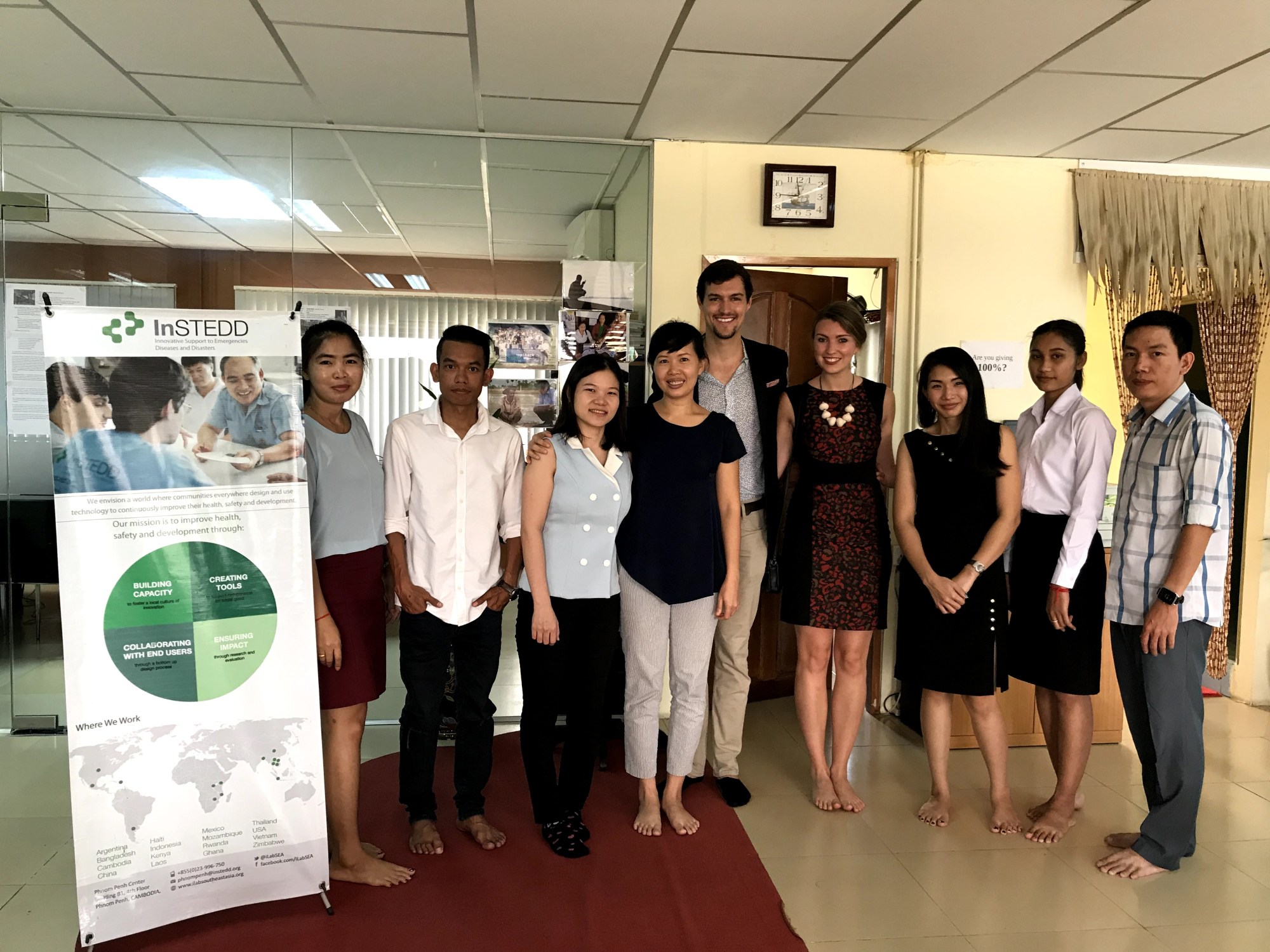
InSTEDD’s iLab Southeast Asia is strengthening the healthcare ecosystem and empowering its heroes
In February of 2006, a physician with the near onomatopoeian name Dr. Larry Brilliant won a TED Prize for his talk on ending Pandemics [1]. His ideas and Google.org funding gave birth to a new kid on the international development block: Innovative Support to Emergencies, Diseases, and Disasters (InSTEDD).
The organization has a tech oriented directive difficult to find in international development, helping “communities everywhere design and use technology to continuously improve their health, safety and development.”
To make this real and impactful, the Silicon Valley based NGO has two Innovation Labs (iLab) on the ground overseas, and we had the opportunity to talk with the head of their iLab in Southeast Asia (iLab SEA) in Phnom Penh, Cambodia: Channé Suy Lan. We learned about the iLab framework for healthcare technology innovation in developing healthcare ecosystems and how, in small steps, they are using healthcare technology to strengthen the healthcare ecosystem in Cambodia and empower its heroes.
The iLab SEA framework had four components: government relationships, human resources, impactful, specific projects, and of course, funding (while important, funding will not be discussed in detail here). However, this was the first example of an NGO we had come across that had fostered strong, healthy relationships with public health officials, and was also completely run by locals. We were intrigued.
Healthy government relationships
In a country that ranks 135 out of 190 in the World Bank’s Ease of Doing Business index, and where low-income patients frequently need to bribe physicians to give them “free” government supplied medications, we did not expect to see a ten member NGO meeting with Ministers of Health and rolling out healthcare tech products to Cambodia’s Centers for Disease Control (CDC). But we did. Channé, the iLab SEA director, says though that “it wasn’t always this way”. At the beginning, they collaborated with smaller, local officials, and even made prototypes that turned an hours-long reporting task into a matter of seconds. Red tape, though, shut it down. Frustrated as these local officials and the iLab SEA team were, they continued to build trust, and trust helped them form their two part government roadmap:
- Identify the government champion. For the Cambodian Disease Prevention Hotline discussed later, this was the director of the Cambodian CDC
- Cultivate relationships not only with them, but with their deputies and junior employees (The deputy director they once built relationships with is now the director).
Through these efforts, InSTEDD has remarkably good partnerships in a disastrously bureaucratic and corrupt healthcare ecosystem in Cambodia, and not only here. Channé met with the Minister of Health from Vietnam the day after we met to discuss next steps from an incubation program they had run. Their roadmap has helped InSTEDD build key government relationships across the region.
Local human resources
The ten member iLab SEA team is entirely Cambodian–a feat many NGOs strive for, and that most miserably fail in attempting. For Channé, “having the local team is key”, and as she began at the iLab SEA’s inception 10 years ago, she breaks down recruitment for launching a similar program into two parts: external, and internal.
- External: “At the start everyone will be brought in from outside [the organization]. We needed team leads for technology and for communications in particular”. Finding a blend of competence and passion for the cause is especially difficult, but “optimizing for the right value proposition is crucial”.
- Internal: Once these leaders have been identified and the organization under them is running, you can begin thinking about growing your leadership from within, and replacing any foreigners as time goes on. Channé noted that some of their best employees came through internships, and recommends that strategy for indigenous conversion. “The goal is to eventually grow from within, and phase out the ‘outsiders’”.
Cambodia faces two unique challenges in locally staffing that make iLab SEA’s accomplishments stand out even more. Many of those here with the credentials for NGO jobs went to an international high school and then onto a university in a foreign language such as English or French. While they can speak Khmer fluently, they cannot read and write it fluently, which disconnects them from the people an NGO may be looking to serve. Additionally, for locals in countries like Cambodia, NGOs often pay more than corporate opportunities, bringing many to the table with the wrong motives.
Project specificity
Core to iLab SEA’s success was specificity in what the scope of the iLab’s work entailed, summarized in three pillars:
- Emerging disease program
- Incubation program
- Youth tech mentorship program
The iLab focused on disease surveillance within emerging disease, encouraging active public participation, and partnering with the Ministries of Health and Centers for Disease Control of different Southeast Asian countries. In the incubation program, the iLab uses design thinking and other lean prototyping standards to design prototypes and solutions with stakeholders ranging from experts to end users. For the youth tech mentorship program, the iLab takes a specially selected cohort of 12 university students through a six month intensive program where students are mentored, learn mobile development, and complete a field application project that produces something of social value. This also builds students’ technological competence to a hire-able level, something that most don’t achieve solely through university courses.
In practice
Taken together, these three aspects of strong government relationships, local human resources, and project specificity have led to numerous success, and we discuss two here: the National Disease Prevention Hotline and a mental health pilot.
In 2016, InSTEDD collaborated with the Cambodian Center for Disease Control to set up a free-to-the-public national hotline that allows healthcare workers and the general public in Cambodia to submit infectious disease reports and access information by dialing 1-1-5 on any phone. The hotline cut down identification of potential endemics from months prior to near real time, and in the first four months had 35,000 calls logged.
More recently, in a design thinking session on mental health including experts, technologists, beneficiaries, and their families, the experts proposed a suicide prevention tool. However, once the families had a chance to speak up, it became clear that this suicide prevention tool was not what they needed; what they needed was support. Tools to help them better understand the challenges their loved ones were facing, tools to support them, and tools to equip them to better love and support their family members with mental health conditions in the more early stages. The silenced experts remained reticent for a while as the conversation shifted, and then helpfully joined back in as the group developed prototypes. As this session happened recently, the tool development is still ongoing, but it illustrates how the iLab brings in the users themselves into the conversation, and does not design in a vacuum.
As InSTEDD looks to replicate successes, they have identified several factors to bootstrap healthcare tech innovations: strong government relationships, local human resources, impactful projects, and funding. There is always more work to do, but it was humbling to meet a team that had promoted capacity building and linkage across the healthcare ecosystem in the Kingdom of Cambodia as well as the surrounding region.
[1] https://www.ted.com/talks/larry_brilliant_wants_to_stop_pandemics
 Elly & Josh