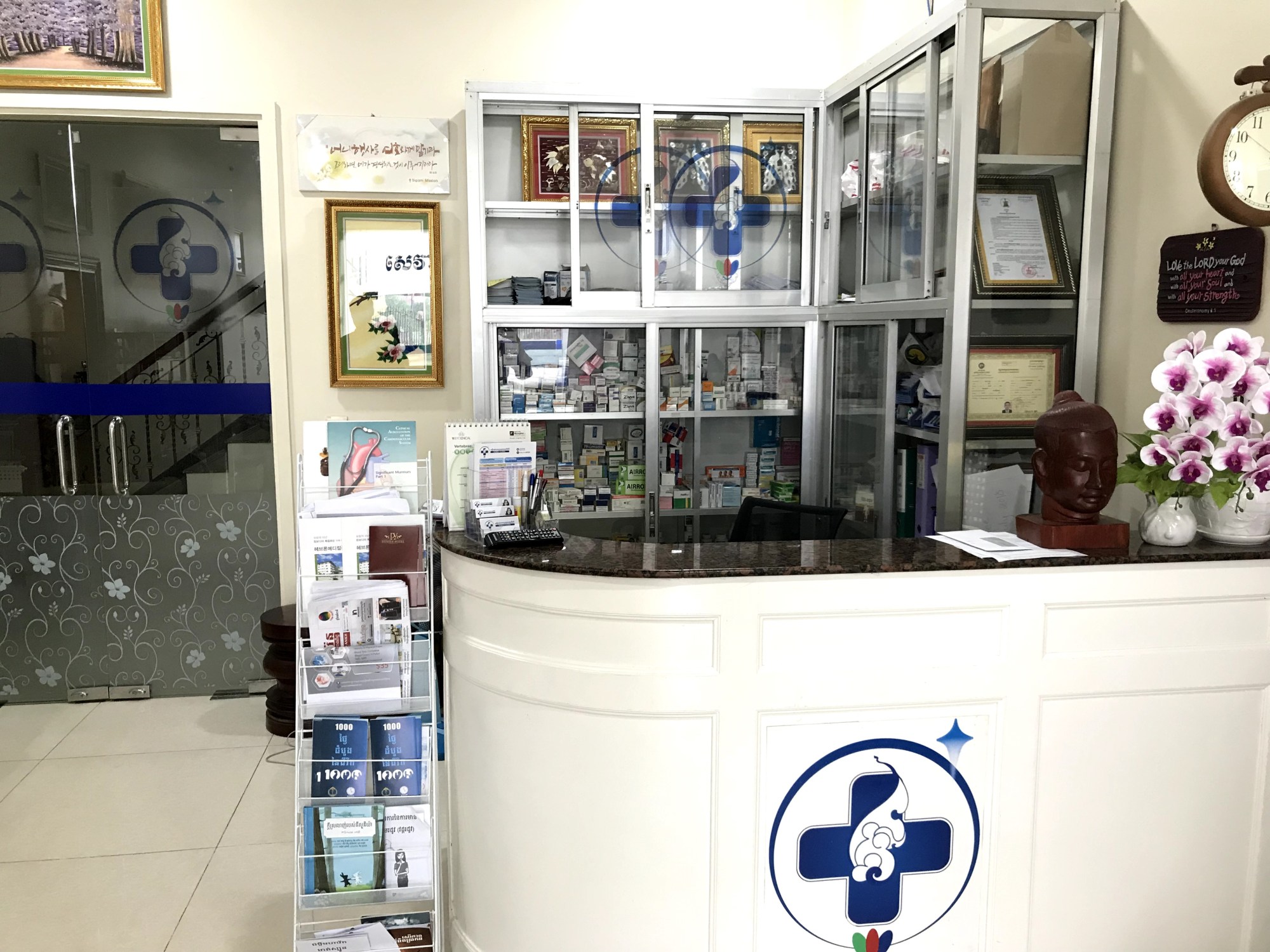
“Cambodians buy medicine as if it’s candy and lollipops” – Cambodian physician
Patients so distrust healthcare in Cambodia that they self-prescribe, and the pharmacies let them. Elise and I tested this out ourselves and with no bribe or prescription walked out of a Phnom Penh pharmacy with amoxicillin (and we could have walked out with Ambien, and two benzodiazipines [Lorazepam and Midazolam] that they were happy to hand to us, like we were buying shampoo or a box of cereal): highly “controlled” substances. But to understand why these and other patient perceptions exist, we need to go back a bit, to the 12th century.

Elly with amoxicillin
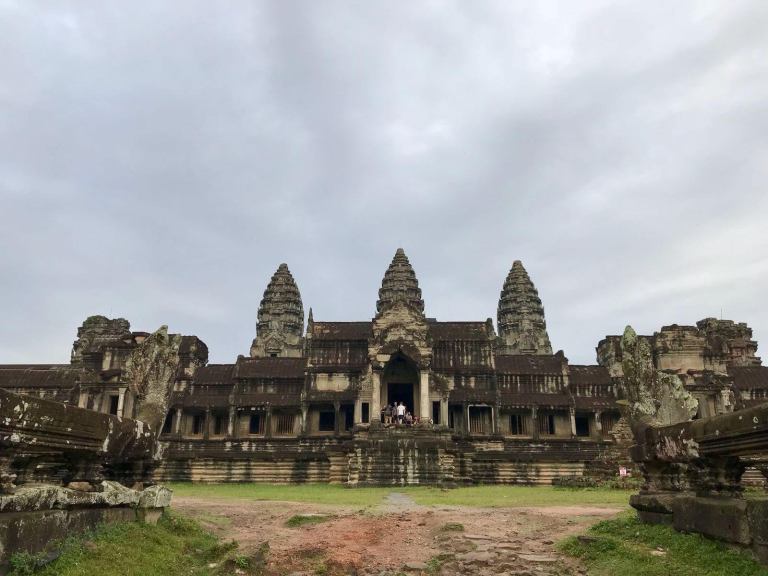
Angkor Wat took an estimated 300,000 workers to build
At a time when 50,000 people lived in London, the Cambodian Khmer empire covered Cambodia, Thailand, Laos, and southern Vietnam, had cities with one million residents, and boasted water works even the Dutch would marvel at. Eight centuries later, the seat of this progress found itself moving backward at the hands of a socialist, communist machine: the Khmer Rouge. As many as 2 million people died in a systematic movement to eliminate anyone with an education or profession in order to construct the perfect agrarian state.

Skulls from the “Killing Fields”, one of hundreds of mass graves across the country where the Khmer Rouge slaughtered its citizens by the masses
Elly and I visited one of the most notorious torture and execution centers, where of the 20,000 doctors, professors, engineers, and “enemies” of the Khmer Rouge brought there, only eleven are known to have survived. The grotesque methods of torture described, the blood stained walls and floors, and the atrocities that took place here and at hundreds of other detention and killing centers across the country left us in tears; they were chilling, horrifying. In a truly disturbing effort to create a “farming utopia”, the “Khmer Rouge” instead killed nearly half the population, and by eliminating the educated and all non-agrarian industry, crippled future development pathways.
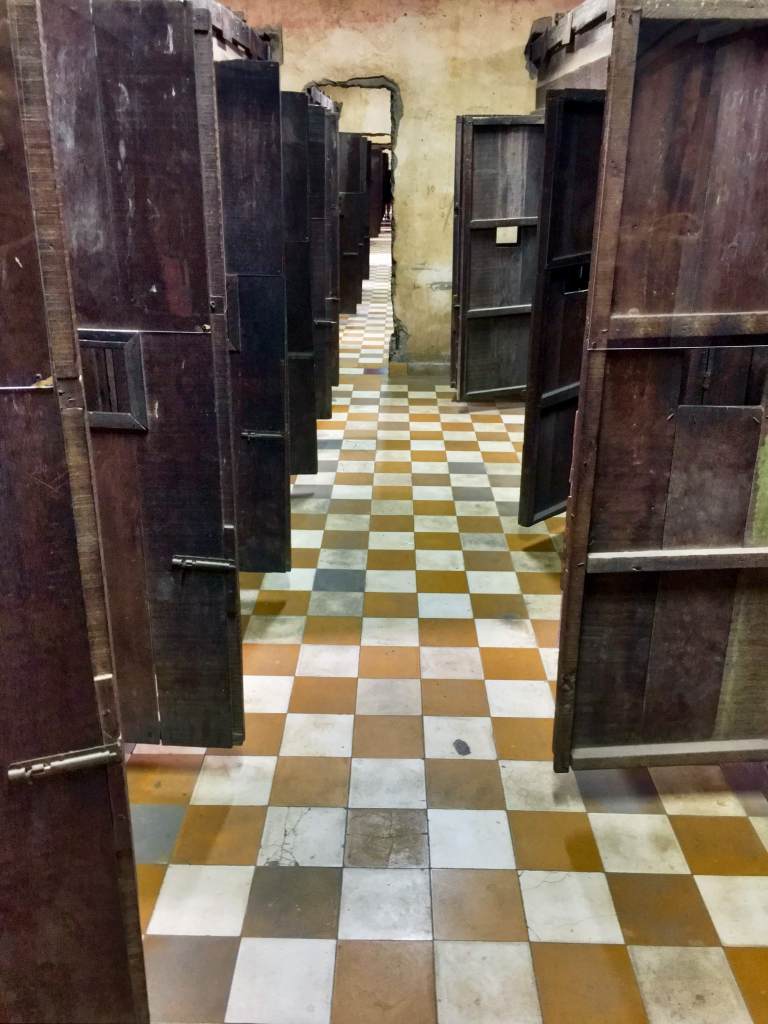
Cells where doctors, engineers, the educated, and “enemies” were held in between torture sessions, which could be as many as three times a day
It is on this pathway that healthcare in Cambodia finds itself now: a pathway where the Khmer Rouge has menaced patients’ perception of healthcare in the country. The rural poor cannot afford it: clinicians often charge for medicine and care that should be “free.” For example, the WHO has provided for free medicine to treat tuberculosis in Cambodia, which physicians and nurses often will not give to patients until they pay for it. Cambodians with financial means do not trust it: many patients “self-prescribe” painkillers and antibiotics that pharmacies give without batting an eye; the middle class goes to Thailand, and the upper class to Singapore for care. And the clinicians in the system give them little reason to trust them: even after eight years of educational training most have barely worked with any patients.
The rural poor
The rural poor struggle with “access” to healthcare. Some do not know what modern healthcare offers, those that do feel they cannot afford it, and as a result, most default to witchcraft or traditional medicine. While in theory the Cambodian Ministry of Health has set up clinics or health centers to provide basic primary care in all provinces, some patients arrive to find no clinicians or supplies. These remote government employed clinicians often open private practices to supplement a more meager government income, and go to the clinic on occasion. This practice is not only limited to rural areas, and urban government hospitals share the same struggle.
A Cambodian physician we met with described the resulting issues with “medicine man” care. A ten year old had fractured her leg in a motorcycle accident and went to the medicine man. She came to the clinic two weeks later and would have needed urgent care because the site was infected and after x-rays they determined her leg was still horribly fractured. However, sadly, her family did not like the diagnosis given so took her back to the village to see the cheaper medicine man, and the clinicians haven’t seen her since.
The rural poor often do not even know healthcare is theoretically available to them, those that do are often disappointed to find clinics empty of clinicians, medicines, or favorable diagnoses, and the perception of harmful traditional medicine practices as helpful continues.
The urban residents
While those in urban areas have more consistent access to healthcare, most patients deeply distrust it and take matters into their own hands and treat themselves. Patients generally do not understand the importance of medical consultation, and are not aware that while “medicine can heal, it can also kill”. A doctor at the family clinic shared a sad story of a woman dying by accidentally overdosing on medicine because she had diagnosed and prescribed them to herself. Many do not know that they are supposed to see a doctor before getting a prescription. In some cases, they don’t even know you’re supposed to have a prescription. And for good reason, as they’ve never had to get one. Patients can easily request and get antibiotics, steroids, and opioids without a prescription. When a friend has something similar to what they have experienced, they’ll share the concoction of pills that they got, and then go to the drug store and demand the same drug cocktail. Patients believe that the more money spent and pills received the better the quality of healthcare. Another physician we spoke to told of a patient who became angry because, when under same condition, another doctor prescribed ten different medications to take, even though they only needed two. This continues in other areas. Patients will order doctors around, demanding they order MRIs or CAT scans for joint pain, or demanding an IV fluid drip for abdominal pain. Patient perception is that medical consultations are not necessary, and that between them and their friends, they know what is better for their health than the physicians.
The system
Sadly, the healthcare system has not given these patients much reason to trust it, as it has struggled to build itself up from the carnage of Pol Pot’s communist Khmer Rouge. It is a system with hospitals where as little as $30 of every $100 allocated for healthcare gets to the patient, and with health clinics that lie abandoned with no doctor, nurse, or supplies. Physicians will “rent” their licenses to younger, non-certified doctors who will run their clinic. Many pharmacies operate with no licenses, or rent theirs to others as there is very little regulation or enforcement. Free medicine (like TB medicine from the World Health Organization) is often “re-sold” illegally because doctors and nurses won’t give it unless the patient pays them. Likewise, in the hospital, nurses ask for bribes to give the patient the medicine they already paid for or should be receiving for free.
As for the clinicians, Cambodia struggles with absent and disinterested physicians, insufficient medical qualifications, and poor clinical education. Doctors often leave to go to their “Cabinets” (offices) and the nurses run the hospital, letting the doctors know when “it’s time for surgery” at which point they may show up. Top, older doctors frequently do not take time to assess before diagnosing. Worse, they often do not allow younger doctors to try and do assessments or more completely learn.
Within clinical education, there is a lack of standardized curriculum, and what is taught is often outdated. Being a professor of medicine is not lucrative nor considered prestigious, so there are not many good medical schools. Doctors come out unprepared and ill-equipped and aren’t trained well in the hospital afterwards. The physicians who do come out often won’t do anything until they see the money, even if a patient comes to the ER after an accident.
Despite these challenges, I believe the hard-working Cambodian people who built magnificent cities and structures can rebuild their healthcare infrastructure, and we spoke with groups who are doing just that. We talked to physicians at a family clinic with 20 physicians and nurses who come on their own time for free because they want to learn from the best trained Cambodian physicians, physicians who are looking to change the Cambodian patient mindset and train the next generation of clinicians. We visited health tech startups collaborating with government health agencies (see last post), and smaller hospitals taking batches of residents to produce strong clinicians.
Seeing present day patient perspectives can paint a pessimistic picture of Cambodian healthcare; however, it is important to recognize where this country with such a rich cultural heritage has come from over the last 40 years. Because of the Khmer Rouge, tn the 80s almost 100% of the population lived below the poverty line and there simply was not any healthcare available. Like any country, Cambodia has opportunities for improvement in its healthcare ecosystem, but it is important also not to forget how far the country has come.
 Elly & Josh